Banff’s average January low sits at -15°C (5°F). Add wind chill on the Icefields Parkway or at the base of the Lake Louise ski area, and the perceived temperature typically drops below -30°C (-22°F). A substantial number of first-time visitors arrive in fashionable puffer coats and leather-soled ankle boots — and spend their first afternoon hunting for emergency socks or a warmer hat along Banff Avenue. This is not legal advice — consult a licensed attorney for any legal matters. But for what to wear in Banff during winter, the guidance below draws from what cold-weather outfitting experts generally agree works in sustained alpine sub-zero conditions.
What Banff’s Winter Temperatures Actually Mean for Clothing
People tend to calibrate “cold” against their home city. That calibration fails in Banff, where the combination of altitude (1,383 meters above sea level), low humidity, and unpredictable wind creates conditions that feel distinctly different from urban winter cold at the same temperature reading. A Canadian from Ottawa in -12°C and a visitor from Miami in -12°C are not having the same experience — and neither is necessarily prepared for what six hours outdoors in January Banff actually requires.
| Month | Average High | Average Low | Wind Chill Risk | Typical Activities |
|---|---|---|---|---|
| November | -1°C (30°F) | -10°C (14°F) | Moderate | Early ski season, town walks |
| December | -5°C (23°F) | -14°C (7°F) | High | Skiing, ice skating, snowshoeing |
| January | -8°C (18°F) | -18°C (0°F) | Very High | Peak winter, Ice Magic Festival |
| February | -5°C (23°F) | -15°C (5°F) | High | Skiing, snowshoeing, ice canyon walks |
| March | 1°C (34°F) | -9°C (16°F) | Moderate | Late ski season, spring thaw |
Wind chill is the column that matters most. Temperature tells you whether you are cold. Wind chill tells you whether your gear is adequate. On a -12°C January day with sustained wind, exposed skin can experience frostbite onset in under 20 minutes. Most packing guides skip this entirely.
Why Activity Level Changes Everything
Cold-weather outfitting experts generally agree that one of the most persistent mistakes in alpine dressing is treating winter clothing as a static problem. In Banff, your body heat output shifts dramatically across a single day. Hard skiing generates enough core heat that many people overheat in heavyweight parkas. That same person standing at the top of Sulphur Mountain for twenty minutes of photos in -18°C wind needs that parka immediately. A layering system is not optional — it is the mechanism that lets you adapt to those swings without carrying a second bag of gear.
The Cotton Problem Nobody Warns You About
Cotton absorbs sweat and holds it. When you exert yourself and then stop moving in sub-zero temperatures, a wet cotton base layer chills against your skin faster than almost any outer layer can compensate. In most alpine cold-weather contexts, cotton is considered unsuitable for any layer worn outdoors below -5°C. This is a consensus position among cold-weather outfitters, not a matter of personal preference. Merino wool and moisture-wicking synthetics are the documented alternatives — and this single swap changes more about your comfort than any jacket upgrade.
The Three-Layer System: What Each Layer Actually Does
The layering framework reflects how heat retention, moisture management, and wind protection each require different materials to function. No single fabric does all three things well. Here is how cold-weather stylists and mountain guides typically structure it:
| Layer | Function | Best Material | Specific Products | Price Range |
|---|---|---|---|---|
| Base (skin contact) | Move moisture away from skin | Merino wool or synthetic | Smartwool Classic 250 Crew, Icebreaker 200 Oasis | $85–$140 |
| Mid (insulation) | Trap and retain body heat | Down or synthetic fill | Patagonia Nano Puff ($279), Arc’teryx Atom LT ($375) | $150–$450 |
| Shell (outer) | Block wind and wet | Gore-Tex or waterproof-breathable | Arc’teryx Beta AR ($799), Columbia OutDry Extreme ($350) | $200–$900 |
For January temperatures below -20°C with wind chill — common in Banff, not exceptional — a fourth layer becomes relevant. That is when a heavyweight insulated parka worn over the full system makes sense. The Canada Goose Expedition Parka ($1,195, rated to -30°C) is the most recognized product in this category. Whether it is worth the price relative to alternatives is a separate question addressed below.
Base Layer: The Decision That Defines Your Entire Day
The Smartwool Classic All-Season Merino Base Layer Top in 250-weight ($90) is the consistent recommendation across alpine communities for Banff’s January conditions. The 250 designation places it in the mid-heavy range — warm enough for static cold but not so heavy it causes overheating during moderate exertion like snowshoeing or resort skiing. Icebreaker’s 200 Oasis ($95) runs slightly lighter and has a softer hand against skin for people who find standard merino textured. Both work. Cotton does not.
Mid Layer: When It Becomes Non-Negotiable
In November or a mild March day above -5°C, many visitors skip the mid layer entirely. Below -10°C, it is part of a functional system rather than a comfort bonus. The Patagonia Nano Puff ($279) compresses to the size of a water bottle, adds meaningful insulation without restricting movement under a shell, and has a documented performance record across alpine environments. The Arc’teryx Atom LT ($375) runs slightly warmer and has a more structured fit for those who want something that looks considered rather than purely utilitarian. Either choice works — the gap between them is smaller than the gap between having a mid layer and not.
The Footwear Verdict
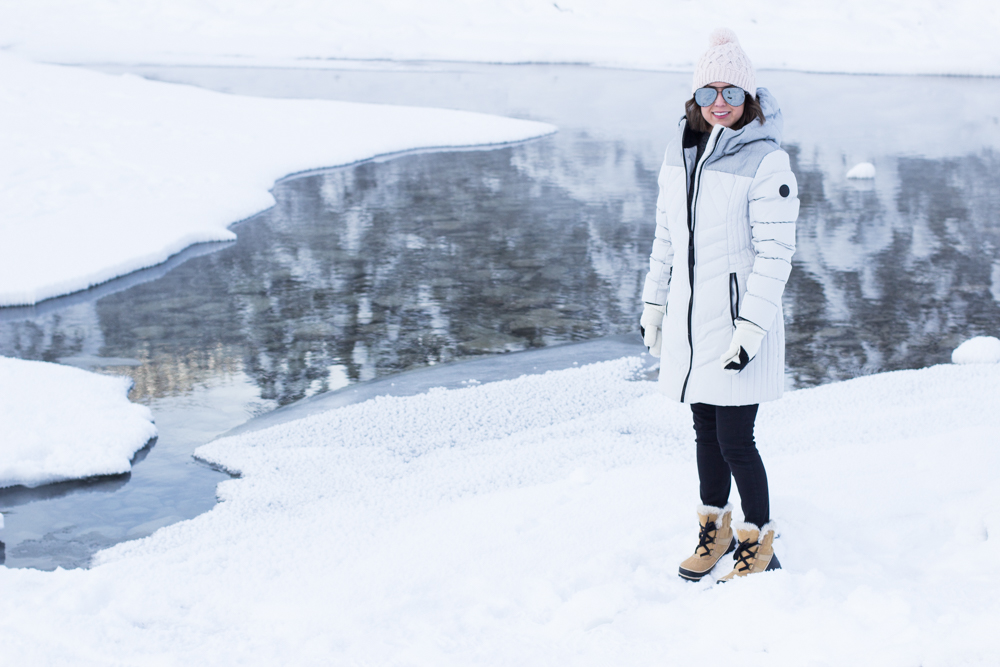
Buy the Sorel Caribou ($200). Rated to -40°C, fully waterproof, and available in enough colorways that the choice looks deliberate rather than purely defensive.
Fashion boots fail in Banff for two reasons. Thin soles conduct cold directly from ice-covered ground into your feet — numbness sets in within 20 minutes regardless of sock thickness. Non-waterproof materials absorb snowmelt the moment you step off a cleared path. Neither problem is solvable with better socks.
The Sorel Caribou has been the standard outfitter recommendation in this region for years, and that consensus exists because the boot consistently delivers on its rating. The Merrell Thermo Chill Mid Waterproof ($180) is a credible alternative for those who prefer a lower-profile silhouette. For visitors committed to some aesthetic intention alongside function, the Sorel Joan of Arctic ($260) bridges that gap more convincingly than anything else at this temperature rating.
One pair of Darn Tough Vermont Merino Wool socks ($25) completes the system. Do not double up on socks — restricted circulation actually reduces warmth and creates discomfort over long active days.
Six Packing Mistakes That Leave Visitors Suffering
- Packing cotton base layers. The single most consequential error. Cotton holds sweat against skin in cold temperatures and chills rapidly when you stop moving. Replace all cotton underlayers with merino wool or moisture-wicking synthetic before packing anything else — this one swap matters more than any jacket upgrade.
- Treating a single heavy coat as the full system. Even a Canada Goose Expedition Parka cannot compensate for the absence of a moisture-wicking base during active periods. The layering system is the solution, not a thicker single garment. A $90 base layer plus a $180 mid layer outperforms a $1,200 parka worn alone on a ski day.
- Underprotecting extremities. Cold-weather experts generally agree that hands, ears, and feet account for a disproportionate share of winter discomfort and cold-weather injury. Bring liner gloves that fit inside heavier mittens. A wool buff covers the neck gap and can be pulled over the nose in wind. A thin beanie is not adequate for sustained -20°C wind exposure.
- Fashion boots on icy terrain. Banff parking lots, sidewalks, and trailheads are effectively glaciated from December through February. Smooth-soled or low-cut boots are a slip-and-fall risk. If aesthetics matter to you, the Sorel Joan of Arctic handles both requirements without compromise.
- Skipping sun protection in winter. Frostbite and sunburn can coexist on the same face. UV intensity increases with altitude, and fresh snow reflects approximately 80% of incoming ultraviolet radiation back upward. SPF lip balm and sunscreen on exposed facial skin are standard recommendations for any Banff winter day with visible sun.
- Packing for après, not for outdoors. Banff’s restaurants and lodges are warm. Your heavy layers check at the door. The consistent error is overpacking stylish indoor options and underpacking outdoor layers. The outdoor system takes priority — indoor warmth is provided by the building.
Canada Goose vs. Arc’teryx vs. Columbia: A Direct Comparison
For active winter days in Banff — skiing, snowshoeing, long canyon hikes — Arc’teryx is the technically superior choice. For sustained static cold exposure — watching the Ice Magic Festival sculptures, photography at Lake Louise, standing on a viewing deck in January — Canada Goose delivers warmth that Arc’teryx shells are not designed to match. Columbia is the correct answer for anyone unwilling to spend $800 on a jacket they wear one week per year.
Canada Goose: Static Cold Performance at a Premium
The Canada Goose Expedition Parka ($1,195) uses 625-fill-power down in Arctic Tech fabric with a coyote fur ruff that genuinely blocks wind from reaching the face. It is rated to -30°C and performs at that rating in static conditions. The cut is not designed for high-exertion activity — range of motion is more restricted than technical shells, and the insulation level causes overheating during sustained skiing or hiking. Its documented use case is extreme static cold. Wearing it on chairlifts typically means arriving at the top overheated and damp.
The Canada Goose Freestyle Vest ($450) is arguably the more practical purchase for many Banff visitors. It provides core insulation without overheating the arms during activity, and layers cleanly under a shell on colder days.
Arc’teryx: The Active-Day Standard
The Arc’teryx Beta AR jacket ($799) is a Gore-Tex Pro shell — waterproof, breathable, and cut for full range of motion on the mountain. On ski days and extended active outings, it outperforms any Canada Goose equivalent because it manages moisture and movement rather than prioritizing static warmth retention. Pair it with the Arc’teryx Atom LT mid ($375) and a Smartwool 250 base and you have a complete system that handles the full temperature and activity range Banff winter delivers — without overheating during exertion or underpreparing for stops.
Columbia: Legitimate Performance Below $400
The Columbia Bugaboo II Fleece Interchange Jacket ($180) uses the brand’s Omni-Heat reflective thermal lining, which cold-weather reviewers consistently note performs above its price point. It is not a Gore-Tex shell and it is not a heavyweight parka. For visitors who cannot justify $800 on a jacket worn infrequently, it functions adequately in temperatures above -15°C when paired with a merino base layer. The Columbia OutDry Extreme ($350) is a step up — a waterproof-breathable shell that approaches technical shell performance at roughly half the Arc’teryx price point, and a credible choice for the budget-aware visitor who still wants real protection.
Accessories That Solve Real Problems in Banff Winter
What actually protects your hands in sustained cold?
A liner-and-mitten system outperforms a single thick glove in most Banff conditions. A thin merino liner (Smartwool makes a $30 version) worn inside the Black Diamond Mercury Mitts ($95) delivers warmth comparable to much heavier single-glove systems while preserving enough dexterity for zippers, buckles, and camera controls. Running bare-handed below -15°C for any sustained period is medically inadvisable — frostbite on fingers can begin in under 10 minutes at -20°C with wind. The liner-plus-mitten approach also lets you strip the mitten for fine motor tasks without exposing bare skin to ambient air.
Do you actually need a balaclava, or does a neck gaiter work?
For most Banff winter conditions, a Buff Original Neck Gaiter ($25) closes the gap between jacket collar and hat, and can be pulled up over the nose and lower face in wind. That covers the majority of visitors on the majority of days. Below -20°C, or for people with high cold sensitivity in facial skin, a balaclava that covers nose and cheeks is the stronger choice. The Turtle Fur Comfort Shell Ninja Balaclava ($45) threads the needle between coverage and breathability better than most alternatives at this price. A balaclava is situational rather than universal — the Buff handles most scenarios and weighs almost nothing.
What kind of hat is actually adequate at -18°C?
Full-coverage merino wool. A hat that covers your ears completely and sits low enough that wind cannot push underneath the brim. The Smartwool Merino 250 Cuffed Beanie ($40) meets this standard. Folded-brim fashion beanies, baseball caps, and thin acrylic knits are appropriate for March — not for January in an exposed alpine environment where wind is a constant factor.
The layering system beats any single garment, every time — that is the one principle that holds across every winter destination at altitude.