You know the scenario. You try the skirt on in the store, it looks incredible, you buy it. Then you get home and realize you have absolutely no idea what to pair it with. After three failed attempts — too much here, wrong shoes there — it goes to the back of the wardrobe where it lives indefinitely as an expensive reminder of misplaced confidence.
The skirt isn’t the problem. The styling approach is.
Leopard print has a reputation it doesn’t entirely deserve. People write it off as “too much” before they understand what actually makes it work. The truth is it’s one of the few patterns that can function as a neutral — if you treat it correctly.
The Real Problem With Leopard Print Isn’t the Print
Most styling guides frame leopard print as a bold statement piece. That framing is where things go wrong.
When you think of something as “bold,” you mentally give it permission to dominate the outfit. You start asking what you can pair with it that “tones it down.” That question leads to overcomplicated outfits full of competing decisions. The skirt ends up fighting everything around it, and the result reads as costume rather than outfit.
Here’s the more useful reframe: a leopard print skirt in browns, tans, and blacks operates like a patterned neutral. It contains the same colors as a camel coat or a black turtleneck — just arranged differently. Once you stop treating it as the antagonist of your wardrobe and start treating it like any other earth-toned piece, the styling becomes significantly less stressful.
This matters because it changes which clothes you reach for. Instead of searching for things that “go with leopard,” you’re dressing normally in your existing color palette and the skirt fits in naturally.
The exception: if your leopard print skirt skews bright — heavy orange, electric blue, or high-contrast black and white — it does read as a statement piece and needs more deliberate surrounding choices. Most mid-market leopard print skirts fall into the warm neutral category. The bright versions are rarer and require a different approach entirely.
Why Fabric Changes Everything
A leopard print skirt in cheap polyester satin reads as going-out wear regardless of how you style it. The same print on a matte jersey or cotton blend reads as daywear. This single variable affects your entire wardrobe equation before you even open your closet.
Before troubleshooting an outfit, check the fabric. Zara’s satin-finish animal print mini skirts (~$50) are deliberately going-out focused. Mango’s printed midi skirts in ponte fabric (~$70) can go to the office without anyone questioning it. These are genuinely different garments that need different companions — treating them the same way is the first mistake most people make.
Proportions Matter More Than Color Matching
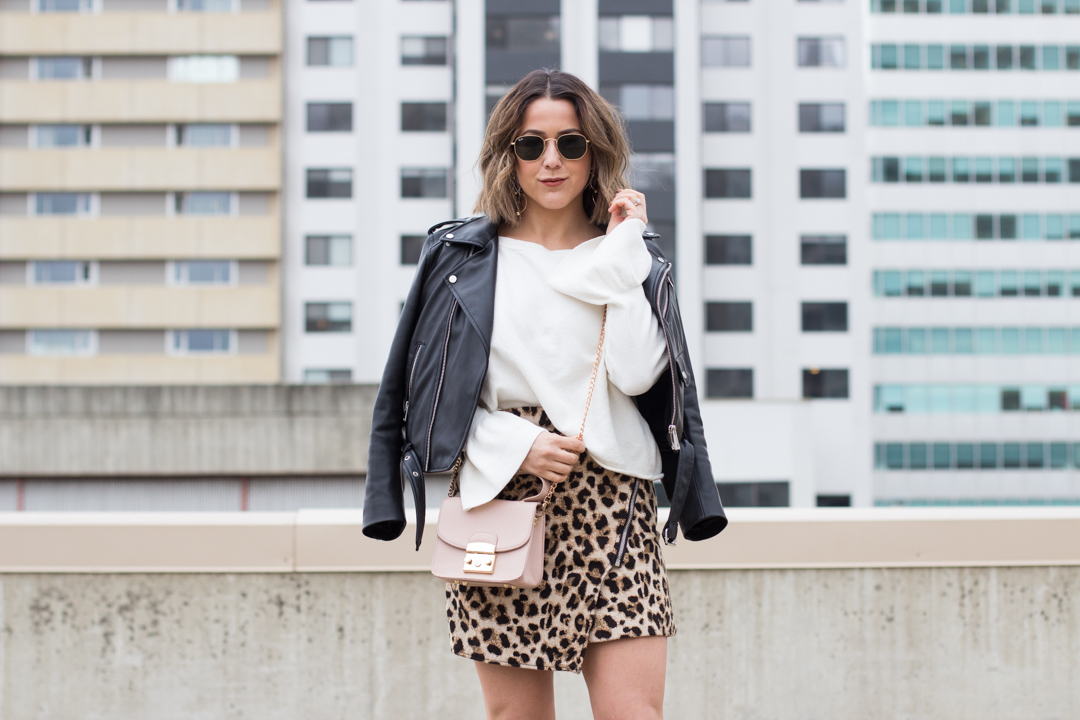
The most common complaint: “I put something with it and it looked like too much.” Nine times out of ten, the issue is proportion, not color. A fitted bodycon top with a fitted pencil-length leopard skirt creates visual noise from the waist down. A loose, oversized top tucked loosely into a fitted leopard skirt creates one strong silhouette — the print gets breathing room.
One fitted element, one relaxed element. Every time. That’s the rule, and it almost never fails.
Mini, Midi, or Maxi: Picking the Right Leopard Skirt Length
The length determines where and how you can wear the skirt more than any other single factor. Here’s what each silhouette actually delivers:
| Length | Best Occasions | Pairs Well With | Key Pitfalls | Mid-Market Price |
|---|---|---|---|---|
| Mini (above knee) | Evenings out, weekend brunch | Chunky knit, blazer, turtleneck | Hard to adapt for workplace settings | $25–$60 |
| Midi (knee to mid-calf) | Office (right fabric), dinners, casual days | Fitted crewneck, linen shirt, denim jacket | Can shorten shorter frames if unbelted | $50–$120 |
| Maxi (full length) | Vacations, weekend events, outdoor markets | Simple white tee, sandals, minimal jewelry | Requires deliberate shoe choice or look collapses | $60–$150 |
The midi is the most versatile length by a clear margin. It’s the only one that moves between settings — from a Tuesday at work to a Saturday dinner — without requiring a completely different approach. If you’re buying one leopard print skirt, a midi in a matte fabric earns its wardrobe real estate.
The mini looks great but lives in a narrow social window. The maxi is a commitment most wardrobes aren’t built to support on a regular basis.
Bottom Line: Buy a midi first. Add a mini if specific outings call for it. Skip the maxi unless you have a concrete use case beyond “it looked good on the model.”
Five Outfit Formulas That Remove the Guesswork
Stop trying to improvise from scratch every time. These five combinations work because they each have a clear visual logic — not because they happen to be trending:
- The All-Neutral Stack: Cream or camel turtleneck tucked into a leopard midi skirt. Brown loafers or ankle boots. No accessories required. This outfit needs nothing added because the print provides all the visual interest. Adding a statement necklace is a mistake here — it creates competition where none is needed and the whole thing tips into overdone territory.
- The Denim Anchor: Dark denim jacket, white or off-white fitted top underneath, leopard skirt. The denim grounds the print and keeps the whole look casual without looking careless. Works for brunches, weekend errands, low-stakes outings where you want to look intentional but not assembled.
- The Blazer Upgrade: Solid oversized blazer in camel, black, or white. Simple tucked top. Leopard skirt. Pointed-toe heels or kitten mules. This takes the skirt from casual to dressed without changing the skirt at all. It’s the fastest way to make a $30 H&M leopard skirt read as a deliberate choice rather than a random grab.
- The Monochrome Black Base: All black on top — fitted long-sleeve or a silk camisole with a light layer — black tights in colder months, leopard skirt. The print pops against the black because it already contains black within the pattern. Works for evening outings without looking like you coordinated everything within an inch of its life.
- The Fine Stripe Mix: Breton stripe in navy and white tucked into a leopard midi skirt. This is the one clean instance where mixing prints works — fine stripes and animal print don’t compete because they operate at different visual scales. Thin stripes recede. Leopard advances. They coexist without conflict, and the result looks genuinely considered rather than accidental.
Every formula here has a logic you can extrapolate from. Once you understand why each one works, you can adapt rather than follow rigidly.
Honest Answers to the Questions People Actually Ask
Does print quality matter as much as people claim?
Yes, and more than most people realize until they’re standing in the store holding two skirts at very different price points. A high-quality leopard print has irregular spot sizes, varied density, and doesn’t tile visibly across large sections of fabric. A budget print has perfectly uniform spots in a repeating pattern — up close, you can see exactly where the tile starts again. & Other Stories consistently gets print density right on their leopard pieces ($95–$120). ASOS’s own-brand versions at $35–$45 are noticeably more mechanical. You can absolutely wear the ASOS version and look good, but you’re working harder with the rest of the outfit to compensate for what the print doesn’t do on its own.
How much jewelry is too much with a leopard skirt?
Small gold hoops are fine. A statement necklace only works if the top underneath is completely solid and minimal. Stacked bracelets plus bold earrings plus a leopard skirt plus a textured top is too many conversations happening simultaneously — the result reads as cluttered, not curated. The skirt is already providing visual interest. Treat it as the jewelry and dress the rest of the outfit as the setting around it.
Can leopard print actually work in a professional setting?
A leopard print midi in matte ponte or a wool-blend fabric, paired with a tucked solid blouse and a structured blazer, is unambiguously appropriate in a business casual environment. The same print in satin at mini length is not. The print itself is neutral on the professionalism question — the fabric, length, and surrounding pieces make the determination. Anyone who tells you animal print categorically doesn’t belong at work is making a blanket judgment that doesn’t hold up under specifics.
Which Brands Consistently Get Leopard Print Right
Zara and & Other Stories are the two mid-range brands that consistently deliver on both print quality and silhouette. That’s not based on their marketing — it’s based on what actually looks intentional in practice and holds up past the first wash cycle.
Zara’s leopard pieces move fast and sell out regularly. The satin mini skirt ($49.90) and the pleated midi version ($59.90) are the ones worth tracking. The satin finish limits their versatility to going-out contexts, but the cuts are sharp and the proportions are well-calibrated for exactly that purpose. If you need a leopard skirt for evenings and events at this price point, Zara is the efficient choice.
& Other Stories sits higher at $85–$120 and earns the premium. The prints are less uniform, the fabrics hang better, and the construction is more deliberate. Their leopard print midi skirts — when in stock — are the best mid-range option that actually transitions into professional settings. Worth paying the extra $30–$40 if you need the skirt to work across contexts rather than just one.
H&M’s leopard pieces at $25–$40 are exactly what they cost. The prints tile more visibly and the fabrics don’t drape as cleanly. Worth buying if you’re testing whether you’ll actually reach for a leopard skirt before committing real money to one. Not worth it if you’re looking for something that survives two or three seasons without looking obviously budget.
Mango’s printed midi in their standard mid-weight fabric (~$70) is the best value specifically for workwear-adjacent styling. Free People does a maxi version (~$120–$148) with an irregular hem that works for travel and casual outdoor settings — but it’s not a professional garment and shouldn’t be purchased as one.
Bottom Line: & Other Stories for versatility and longevity. Zara for going-out, budget-conscious buying. Mango for the office-appropriate option. H&M only if you’re trialing the trend before committing.
The One Rule That Applies to Every Leopard Outfit
Keep everything else simple. Every time a leopard print outfit reads as too much, something else in the outfit is competing for attention. Remove it. The print is already doing its job — let it.
When to Skip the Leopard Skirt and Choose Something Else
Leopard print doesn’t belong everywhere. Knowing when to put it back is as valuable as knowing how to style it.
Formal dress codes — black tie, traditional weddings, gala events — aren’t the right context for a leopard skirt in almost any configuration. Even a well-cut leopard midi in an excellent fabric reads as too casual for these settings. This isn’t a judgment on the print itself; it’s an occasion-matching problem with a simple solution: wear something else.
If you’re already drawn to a heavily textured top — velvet, brocade, heavy lace — adding a leopard skirt creates pattern and texture overload at the same time. Choose one. The textured top with a solid skirt, or the leopard skirt with a smooth, simple fabric on top. Not both.
If your wardrobe runs predominantly cool-toned — lots of grey, navy, cool white, dusty rose — a warm-toned leopard print in brown and tan will feel consistently disconnected every time you try to build an outfit. A black and white leopard print reads cooler and integrates more naturally into a cool-toned wardrobe. Worth checking your existing palette before buying any leopard piece.
There’s also a practical question worth asking honestly: if you’ve bought animal print before and it’s sat unworn, the issue probably isn’t the specific skirt. It’s that your lifestyle doesn’t naturally create occasions for it. An unworn $80 skirt is a worse outcome than a worn $30 one. Buy for where you actually go, not for a version of your schedule you’re planning to have eventually.
This article covers general styling guidance. Individual results vary based on personal proportions, existing wardrobe, and occasion. This is not personal style advice.