You spot one in a shop window. Navy and white, clean lines, looks effortless on the mannequin. You buy it. You get home. You put it on and something’s off — it looks like a costume, not a wardrobe staple.
That’s not a you problem. It’s a fabric, fit, and stripe-width problem. Fix those three things and the stripe turtleneck becomes one of the most versatile cold-weather pieces you’ll own.
Why the Stripe Turtleneck Has Never Actually Left Fashion
The Origin That Explains the Aesthetic
The stripe turtleneck traces back to 1858. The French Navy standardized a marinière — a dense cotton jersey with 21 white stripes on a navy ground, one for each of Napoleon’s victories. Sailors wore them for visibility at sea. If a man went overboard, the high contrast made him easier to spot.
Functional. Clean. Graphic.
Coco Chanel borrowed this shape from Breton fishermen for her 1917 collection and put it on women. The design entered fashion. It never left. Picasso wore one in almost every photograph taken of him. Audrey Hepburn wore one in Funny Face. The piece has survived because it occupies a rare position: casual and composed at the same time. That dual quality is genuinely hard to find in a single garment.
Why the Turtleneck Version Specifically Works
The crew neck Breton is the more common version. The turtleneck takes it further — adding warmth, adding visual structure around the neck, and replacing the need for a scarf in most conditions. That practical function gives it a reason to exist beyond pure aesthetics.
But the turtleneck neck is also less forgiving. A thin, floppy neck roll in polyester looks cheap. A structured cotton or merino neck that holds its shape reads polished. This is where most budget stripe turtlenecks fall apart — the fabric lacks enough body to keep the roll upright, so it droops and bunches against the collarbone.
What Separates Classic From Costume
Stripe width is the biggest variable most buyers ignore. The original marinière used stripes roughly 10mm wide on dense cotton jersey. Wide stripes — anything over 25mm — on a lightweight fabric start reading theatrical. That’s the costume effect. Keep stripe width under 20mm and the piece stays grounded.
Saint James and Armor-Lux, both French brands still producing these garments in Normandy, have maintained these proportions for over a century. When people say a stripe turtleneck looks right, they usually mean it echoes these dimensions — even if they’ve never seen a marinière in person.
The Four Stripe Turtleneck Styles Worth Owning
Not all stripe turtlenecks are interchangeable. These four distinct styles each serve a different purpose in a wardrobe, and buying the wrong one for your needs is how most people end up with something unworn.
Classic Breton Turtleneck
Navy and white, narrow stripes, dense cotton. The Saint James Ouessant ($150–$180) is the benchmark for this style — heavier than you’d expect, slightly boxy, with stripe width around 10mm. Armor-Lux makes a closely comparable version for $90–$120. Both are manufactured in France and both will outlast anything from a fast-fashion retailer by several years. The cost-per-wear math strongly favors them over cheaper alternatives.
This style works best in a slightly relaxed fit. Not baggy, but not body-con. It’s a workwear shape that happens to look good everywhere from a Saturday market to a casual office.
If you’re between sizes in a Saint James or Armor-Lux, size down. The cotton relaxes noticeably after a few wears and the body opens up.
Fine-Knit Merino Stripe
More versatile than the Breton. Lighter, softer, and much easier to layer under a blazer or structured coat without bulk. Uniqlo’s Extra Fine Merino Turtleneck comes in striped versions seasonally and sits around $50–$60. J.Crew’s Tissue Turtleneck in stripe runs about $80 — thinner gauge, good for transitional weather when you don’t need full insulation.
This is the version you wear to the office under a blazer. Less sailor, more architect.
Check the fiber content: 100% merino or at least 85% merino is worth the price. Merino-acrylic blends pill visibly after 10–15 washes, especially at the collar where the fabric contacts skin constantly.
Oversized Chunky Knit Stripe
This style requires more thought. A large-gauge stripe turtleneck in an oversized cut can look intentional or look chaotic — the difference is usually the bottom half. Keep trousers clean, straight, and unpattern. No logos visible elsewhere. & Other Stories and COS both produce this style seasonally in the $80–$120 range. Avoid stripe widths over 3cm in this format — at that scale on a chunky knit, the graphic intensity overwhelms the rest of the outfit.
Slim-Fit Fine Stripe
Thinner stripes on a slim-fitting turtleneck — often in multi-color combinations rather than classic navy and white. Petit Bateau makes excellent versions in cotton-modal blends at $60–$80. The slim cut and narrower stripe read more refined than the classic Breton, which makes it easier to pair with tailored pieces and dressier occasions without looking like you came from a beach.
Fabric Comparison: What You’re Actually Buying
The stripe is visible. The fabric is what determines whether the piece holds its shape, feels good against the skin, and survives multiple seasons of regular wear.
The Two Fabrics Worth Spending On
Dense cotton and merino wool consistently perform best. Dense cotton — the kind used in a proper Saint James or Armor-Lux — is durable, machine-washable, and holds its structure wash after wash. Merino is warmer, softer, and more versatile for layering under tailored pieces. The trade-off: merino requires more careful washing and pills slightly faster at friction points like the collar rim and underarms.
Cotton-modal blends (used by Petit Bateau and similar brands) are a reasonable middle ground for lighter-weight versions. Softer than pure cotton, easier to care for than merino. Just not as warm, and the modal component can cause the turtleneck neck to lose its shape faster over time.
What Cheap Stripe Turtlenecks Actually Cost You
Acrylic and polyester blends pill within a season. The turtleneck collar specifically shows this — constant rubbing against your chin creates visible fuzz at the collar rim within weeks of regular wear. A $25 acrylic piece needs annual replacement. A $90 Armor-Lux in proper cotton will outlast five of those with no meaningful quality loss.
| Fabric | Warmth | Durability | Care | Best Use | Price Range |
|---|---|---|---|---|---|
| Dense Cotton | Medium | High | Machine wash cold | Classic Breton, daily wear | $50–$180 |
| 100% Merino Wool | High | Medium-High | Hand wash or wool cycle | Layering, office wear | $50–$200 |
| Cotton-Modal Blend | Low-Medium | Medium | Machine wash cold | Transitional weather, slim fit | $40–$90 |
| Cashmere | Very High | Low — pills easily | Hand wash only | Dressed-up occasions | $150–$500+ |
| Acrylic / Polyester Blend | Medium | Low | Machine wash | Short-term trend wear | $15–$50 |
One note on cashmere: skip it for stripe turtlenecks unless you’re spending over $200 with a known brand. Budget cashmere (under $100) in a graphic stripe performs like expensive acrylic in terms of longevity. The fabric and the graphic pattern don’t combine well at lower price points — neither element elevates the other.
How to Style a Stripe Turtleneck Without Looking Costumey
The Rule About Bottoms
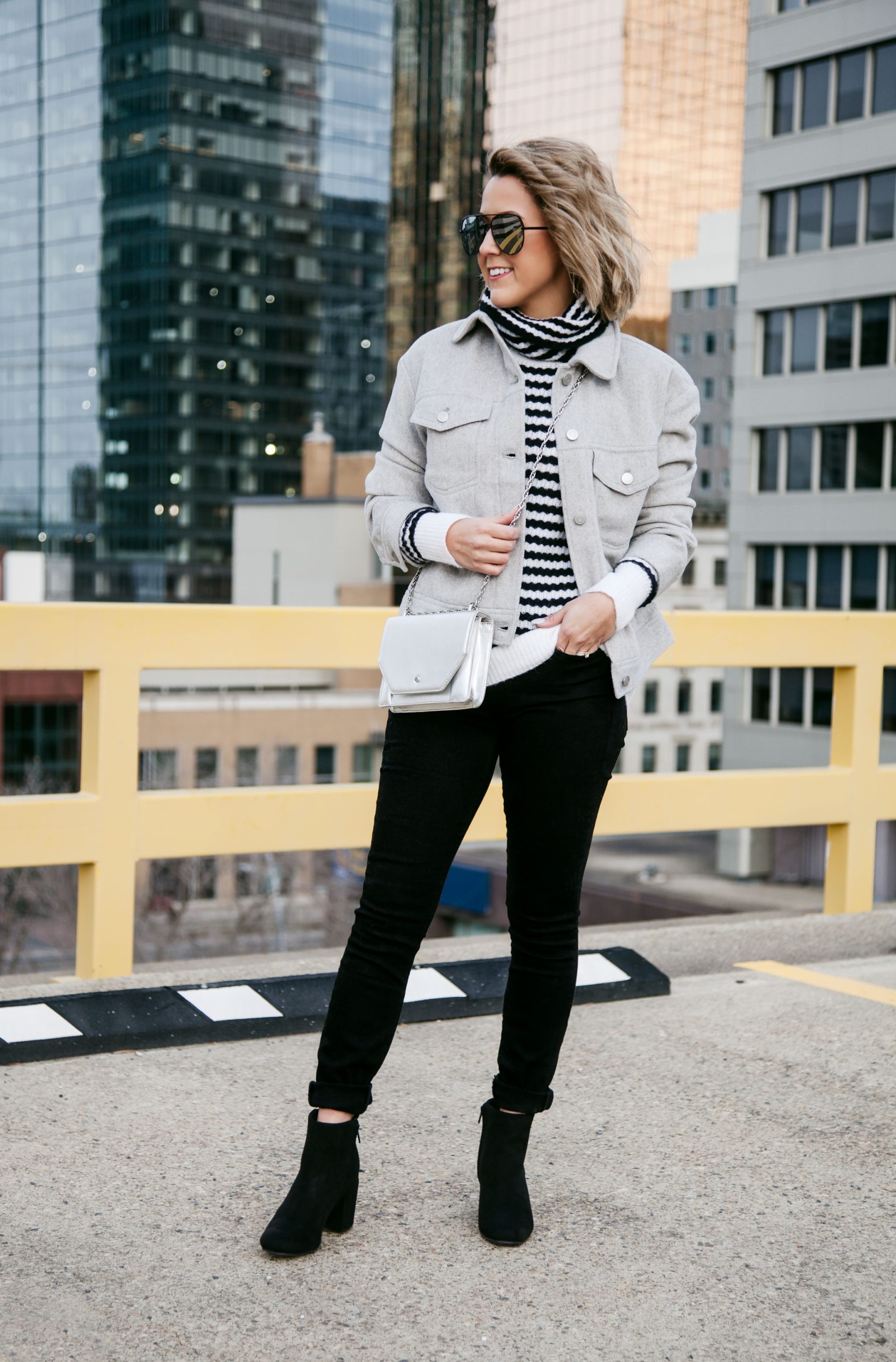
Horizontal stripes on top create visual width. Your bottoms need to be clean, plain, and uncluttered. Straight-leg jeans in dark rinse: reliable. Wide-leg black trousers: strong combination. Pleated chinos in camel or olive: works well. Another print or pattern on the bottom: almost never good.
The single most reliable bottom for a stripe turtleneck is straight-leg dark denim. It grounds the outfit, reads as casual without being sloppy, and lets the stripe do the expressive work without competition from the lower half.
Layering It Right
Over: a camel coat over a navy-and-white stripe turtleneck is one of the most classic combinations in European street style. The warm neutral reduces the graphic intensity of the stripe just enough to make the outfit readable rather than overwhelming. An olive field jacket works similarly. A black leather jacket reads younger and more downtown — valid if that’s the direction, but a different look entirely.
Under a blazer: choose the fine-knit merino version, not the thick cotton Breton. A dense cotton turtleneck under a structured blazer creates bulk at the shoulders and under the lapels. Merino lies flat and keeps the silhouette clean enough to look intentional.
Avoid wearing a stripe turtleneck under an open-collar shirt. The stripe visible through the collar opening reads cluttered, not layered. If you want the turtleneck to peek out, keep the shirt fully buttoned except for the top button.
When to Keep Everything Else Quiet
A stripe turtleneck is already doing expressive work. It doesn’t need help. One watch. No necklace — it competes with the neck roll and disappears anyway. No visible logos elsewhere in the outfit. The stripe is the statement. Everything else should be a supporting character, not a co-lead.
Three Fit Mistakes That Ruin a Good Turtleneck
Mistake 1: Too Much Neck Roll
A turtleneck should fold once, maybe twice at most. If you’re getting an accordion effect around your neck — multiple bunched rings of fabric — the neck is cut too long for your torso proportions. Some European brands cut the neck quite long by design. If this happens consistently across brands regardless of sizing, look at mock turtleneck or funnel neck versions instead. They sit lower on the neck, create less bulk, and maintain the collar silhouette without the bunching problem.
Mistake 2: Off-Shoulder Seam and Sleeve Length
The shoulder seam should land at your actual shoulder point. Not halfway down the upper arm. An intentionally oversized piece can work — that’s a design choice. But an accidentally dropped shoulder on a regular-fit turtleneck looks shapeless rather than relaxed. Check the shoulder seam placement first when trying on; everything else follows from there.
Sleeve length matters too. The cuff should reach the base of your thumb — roughly 1cm past the wrist bone — when your arms hang at your sides. Sleeves that bunch heavily at the wrist add visual mass in the wrong place and force you to push them up constantly, which just moves the bulk problem higher.
Mistake 3: Buying the Wrong Cut for Your Frame
If the fabric pulls horizontally across your chest or upper back, the body is too small — not the shoulders. The fix isn’t sizing up in length to compensate; that just creates a different fit problem. Different brands cut differently: some run narrow through the body, others give more room across the chest. Read size reviews before ordering online, or try in person when possible. Returning a $150 turtleneck because of an avoidable cut mismatch is a frustrating and completely preventable outcome.
The Best Stripe Turtleneck for Most People
Start with the Uniqlo Extra Fine Merino Turtleneck in stripe (~$55). It’s machine-washable merino — genuinely rare at this price — fits cleanly across most body types, works under a blazer without bulk, and the stripe proportions are well-judged. Wear it through two seasons. If it earns a permanent rotation spot, the Saint James Ouessant at $160 is the natural upgrade: heavier, more characterful, built to last a decade.
Don’t start with cashmere in a stripe. Save cashmere for solids, where the fabric’s softness and drape are the entire point. In a graphic stripe, the pattern draws all the attention — the fiber content under it barely registers, and the pilling risk makes it a poor investment for a piece you’ll actually wear regularly.